.gif)
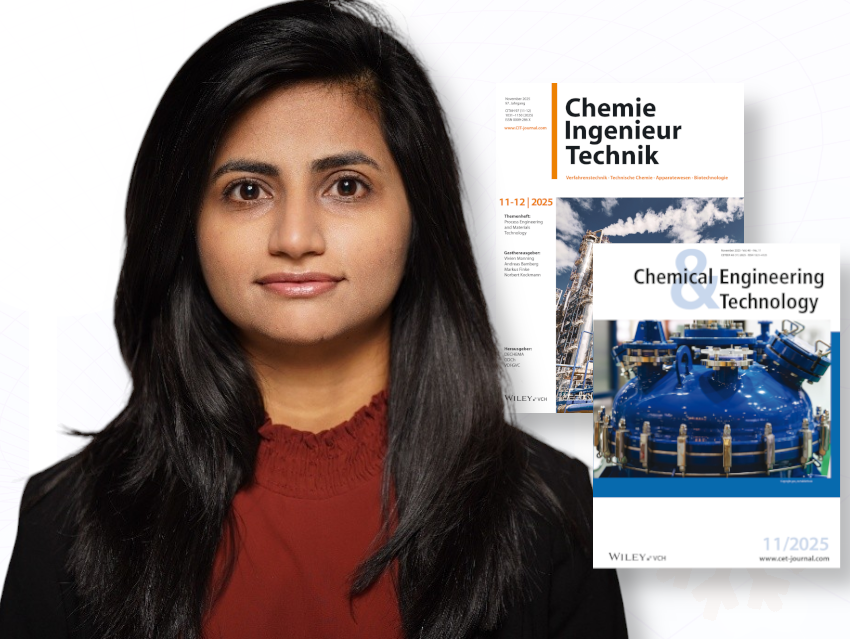
Dr. Shaista Tahir has been named Editor-in-Chief of the journals Chemical Engineering & Technology (CET) and Chemie Ingenieur Technik (CIT). She succeeds Dr. Rosemary (Rose) Puls and Dr. Sabine Wiederhold, effective December 2025.
Chemie Ingenieur Technik and Chemical Engineering & Technology are the official journals of DECHEMA (German Society for Chemical Engineering and Biotechnology), GDCh (German Chemical Society), and VDI-GVC (Association of German Engineers – Process Engineering and Chemical Engineering Division) that cover current research, industrial practice, and technological developments across the full spectrum of chemical engineering.
Shaista Tahir received her Ph.D. in organic chemistry in 2022 from Heidelberg University, Germany, under the supervision of Stephen Hashmi. Her doctoral research focused on homogeneous catalysis, particularly the application of gold in catalytic processes, as well as metal-free organophotocatalysis for organic synthesis. She joined Wiley in 2022 as an Assistant Editor, was promoted to Associate Editor in 2023, and was involved in the peer-review process for Angewandte Chemie, Advanced Functional Materials, Advanced Science, and Macromolecular Rapid Communications.
We spoke with Shaista about her promotion.
What excites you about your new role?
What excites me most is the opportunity to actively shape the strategic direction of the journals and explore new ways of presenting and communicating scientific work in the evolving field of Chemical Engineering. Through emerging research areas, new modes of collaboration, or more dynamic ways of sharing results and being able to steer how we adapt to these changes.
I am particularly looking forward to developing new initiatives that support authors and reviewers, and identifying opportunities where the journals can innovate while staying true to their scientific rigor.
What fascinates you about the journals?
Chemical engineering is a rapidly expanding and increasingly impactful field of research. Both Chemie Ingenieur Technik and Chemical Engineering & Technology hold a strong and esteemed position within the German and broader European community, and a growing broader international audience. Together these journals can really complement each other, offering a unique platform to engage with both regional and global perspectives. This synergy of local excellence paired with international reach is incredibly exciting and has tremendous potential.
What fascinates you about chemical engineering?
Unlike some areas of chemistry that can be highly specialized or abstract, chemical engineering is inherently tangible. Its impact is very easy to visualize in our everyday life in the products we use. In fact, it is difficult to think of a product that did not go through some sort of chemical engineering process. This topic sits at the interface of research and real-life applications and being able to support work that directly shapes practical solutions is uniquely rewarding.
Do you have a message for your predecessors?
Both my predecessors have laid a strong foundation, and I would like to thank them for their hard work and dedication. Their commitment has positioned us well for the future, with the support of our great teams, we will strive to build on that momentum and further strengthen the journals’ visibility and impact.
What do you enjoy doing outside of work?
I often pick up new hobbies to explore in my spare time. Sometimes it is learning to play violin, sometimes swing dancing, or a skill I have never tried before. I enjoy the curiosity and creativity it brings; it keeps my routine fresh and reminds me how fun it is to start out as a beginner.
Many thanks for the interview, and all the best with the journals.
Also of Interest
- Chemie Ingenieur Technik journal homepage
- Chemical Engineering & Technology journal homepage