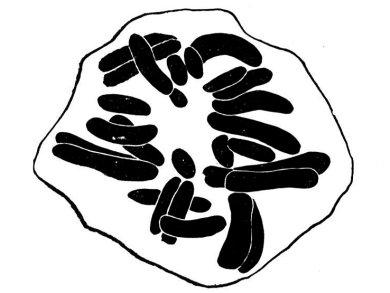
In order to fit long DNA molecules into a cell nucleus, the DNA is compressed with histones and other proteins to form chromatin. A part of the chromatin, the so-called heterochromatin, contains many repetitive DNA sequences. Upon release from their protein coating, they induce the synthesis of non-coding RNAs, which might interfere with important cellular processes. To avoid the formation of these potentially damaging RNA molecules, the stability of heterochromatin is absolutely crucial for the cell’s integrity.
Thomas Jenuwein and colleagues, Max Planck Institute of Immunobiology and Epigenetics, Freiburg, Germany, discovered two enzymes, Prdm3 and Prdm16, which add a methyl group to a histone. The insertion of this methylated histone into heterochromatin is required to prevent the heterochromatin’s breakdown.
- Prdm3 and Prdm16 are H3K9me1 Methyltransferases Required for Mammalian Heterochromatin Integrity,
I. Pinheiro, R. Margueron, N. Shukeir, M. Eisold, C. Fritzsch, F. M. Richter, G. Mittler, C. Genoud, S. Goyama, M. Kurokawa, J. Son, D. Reinberg, M. Lachner, T. Jenuwein,
Cell 2012, 150 (5), 948-960.
DOI:10.1016/j.cell.2012.06.048