News
- The European Commission has launched a Biotech and Biomanufacturing Hub to support companies – particularly start-ups and SMEs – in bringing innovative products to the EU market and increase their competitiveness. The Hub will also help companies identify the support available to them at EU level and how to access this support to help them to expand and grow.
- The Science4Life Business Plan Competition consists of three phases: idea, concept, and business plan. Start-ups and entrepreneurs from life sciences, chemistry, and energy sectors can submit their business ideas online. Participation in the competition is possible at any stage, regardless of whether one has taken part in a previous phase.
Submission deadline for the business plan phase: April 14, 2025
The competition begins with the idea phase, where teams submit a three-page business idea sketch and receive detailed feedback. Selected teams move on to coaching sessions with industry experts. The competition offers €77,000 in prizes and access to a network of over 300 experts, as well as seminars and training materials. Participants can join any or all phases of the competition. - The Institute for Entrepreneurship & Innovation at the University of Bayreuth, Germany, is now supporting ten female scholarship holders in their start-up projects. This is made possible by the new support program “EXIST Woman/ EXIST Frauen” of the Federal Ministry of Economics, which aims to increase the number of female founders in the start-up scene.
- DAAD website offers Ukrainian students and researchers an initial orientation in Germany and specifically in the German higher education and research system, as well as an overview of various assistance services in the academic field.
Finding Grants by Using Online Portals
some of these databases require a subscription, ask your library if they offer one
- Grant Forward is a funding opportunity database and recommendation service built by academics for researchers
- Pivot is a comprehensive search engine for grant funding opportunities available through state, federal, corporate, non-profit, and foundation sponsors
- scientifyRESEARCH is a service that lists research funding opportunities and helps scientists with everything around funding
- Sponsored Programs Information Network (SPIN) is an online database for funding
Funding Opportunities for Young Scientist
Databases produced and posted by Johns Hopkins University (JHU)
– Graduate Student Funding Opportunities
– Postdoctoral Funding Opportunities
– Early Career Funding Opportunities
You find below:
List of Funding Organizations |
German Federation of Industrial Research Associations (AIF)
Registered non-profit association that promotes applied Research and Development (R&D) for the benefit of small and medium-sized enterprises (SME).
Alexander von Humboldt-Foundation
Promotes academic cooperation between excellent scientists and scholars from abroad and from Germany.
American Chemical Society (ACS)
For example, the Petroleum Research Fund (PRF) is an endowed fund, managed by the ACS that supports fundamental research directly related to petroleum or fossil fuels at nonprofit institutions (generally colleges and universities) in the United States and other countries.
Irving S. Sigal Postdoctoral Fellowship (Sigal Fellowship)
Two-year postdoctoral fellowship awarded every two years to a Ph.D. candidate who will pursue research at the chemistry and biology interface. Candidates are nominated by chairs of PhD-granting Chemistry Departments in the United States. Individuals are not able to submit an application without being nominated.
There are no restrictions on the age or nationality of the fellow. The fellowship currently provides $50,000 per year for two years of research at one or more non-profit institutions in any country.
Australian Research Council (ARC)
is the Australian government’s main agency for allocating research funding to academics and researchers at Australian universities. The Australian Research Council has announced $834,000 in new funding towards projects to developing long term research priorities in agriculture, chemistry, the earth sciences, and humanities engagement with Asia in July 2014.
Banting Postdoctoral Fellowships Program
Attracts and retains top-tier postdoctoral talent, both within Canada and internationally, to develop their leadership potential and to position them for success as research leaders of tomorrow, positively contributing to Canada’s economic, social and research-based growth through a research-intensive career. The fellowships are administered by Canada’s three federal granting agencies
- the Canadian Institutes of Health Research,
- the Natural Sciences and Engineering Research Council, and
- the Social Sciences and Humanities Research Council.
The Banting Postdoctoral Fellowships Program completes a federal suite of programs that provide support to highly qualified research personnel at all stages of their careers:
- Canada Graduate Scholarships (CGS) provide financial support to outstanding eligible students pursuing master’s or doctoral studies in a Canadian university.
- Vanier Canada Graduate Scholarships support world-class doctoral students who demonstrate a high standard of scholarly achievement in graduate studies as well as leadership skills.
- Canada Research Chairs (CRC) provide support to new and established investigators for five- and seven-year terms.
- Canada Excellence Research Chairs (CERC) is intended to attract world-class researchers to Canadian universities to work in priority research areas and conduct world-leading research.
Bayer Science & Education Foundation
Boehringer Ingelheim Fonds
is a public foundation – an independent, not-for-profit institution for the exclusive and direct promotion of basic research in biomedicine. It supports researchers and projects aimed to experimentally elucidate basic phenomena of human life and pays particular attention to the promotion of junior scientists.
Bundesministerium für Bildung, Wissenschaft, Forschung und Technologie (Federal Ministry of Education and Research (BMBF)
provides financial support for innovative projects and ideas under targeted research funding programmes. Research funding supports scientific institutions and enterprises. The BMBF also funds individual researchers via special funding institutions.
Cancer Research UK
The world’s leading charity dedicated to beating cancer through research.
Centre National de la Recherche Scientifique (CNRS; National Center for Scientific Research)
The CNRS is a government-funded research organization under the administrative authority of France’s Ministry of Research.
COST (European Cooperation in Science and Technology)
One of the longest-running European instruments supporting cooperation among scientists and researchers across Europe.
Czech Science Foundation (GACR; Grantová agentura České republiky)
Promotes progress over the whole range of basic research in the Czech Republic.
German Research Foundation (DFG; Deutsche Forschungsgesellschaft )
Self-governing organization for science and research in Germany, serving all branches of science and the humanities. Offers a wide range of research project options.
- Heisenberg Professorship Scheme
Funds outstanding researchers who meet all of the requirements for a long-term professorship. - Mercator Visiting Professorship Programme
Funds foreign associate professors. - Reinhart Koselleck Projects
Supports high-risk projects
Howard Hughes Medical Institute (HHMI)
Nonprofit medical research organization that ranks as one of the nation’s largest philanthropies, advances biomedical research and science education in the United States.
Engineering and Physical Sciences Research Council (EPSRC)
Largest governmental funding source in the UK.
ERA-Chemistry
European network of national funding agencies involved in the development and implementation of funding instruments for trans-national collaboration in chemistry. It is a consortium of eleven research funding organizations from ten European countries with the goal to develop and implement joint bottom-up European funding programmes.
ERC (European Research Council)
Funds every year excellent research projects in any scientific discipline, aiming at broadening the scientific and technological knowledge. Top researchers of any nationality and from anywhere in the world can apply, as long as their ERC project will be carried out in a public or private institution based in Europe (EU Member State or Associated Country).
European Commission
The Erasmus programme enables students in higher education to spend between 3 and 12 months in another European country – either for studies or for a placement in a company or other organization. Any student enrolled in a participating higher education institution in one of the 33 Erasmus countries can benefit (EU Member States, Croatia, Iceland, Liechtenstein, Norway, Switzerland, and Turkey).
Erasmus+, the EU programme for education, training, youth and sport, started in January 2014. The seven-year programme will have a budget of €14.7 billion. More than 4 million people will receive support to study, train, work, or volunteer abroad.
Students planning a full Master’s degree abroad, for which national grants or loans are seldom available, will benefit from a new loan guarantee scheme run by the European Investment Fund. Erasmus+ will also provide funding for education and training staff, youth workers and for partnerships between universities, colleges, schools, enterprises, and not-for-profit organizations.
GRANT-IT lists funding opportunities from the European Commission and select Regional and National governments in the field of sustainable chemistry. SusChem and Cefic members can use the resources to search for funding, identify project opportunities, propose project ideas, and search for potential project partners.
Marie Curie Fellowships are European research grants available to researchers regardless of their nationality or field of research. In addition to generous research funding scientists have the possibility to gain experience abroad and in the private sector, and to complete their training with competences or disciplines useful for their careers. Read more about various funding schemes and requirements for applying.
European Commission Environment LIFE+ Programme
EU’s financial instrument supporting environmental and nature conservation projects throughout the EU.
Fonds der Chemischen Industrie (FCI)
Promotes chemistry teaching in schools, basic research and junior scientists.
Research funds are awarded to outstanding establshed and joung scientists at universities and research institutions. PhD candidates and prospective university lecturers are invited to apply for fellowships.
- Stiftung Stipendien-Fonds (Fellowship Foundation)
accepts applications from EU nationals with excellent academic achievement and a rapid completion of studies. - Fellowship for Future Schoolteachers in Germany
- The Kekulé Mobility Fellowship promotes PhD students in chemistry or related fields, who move – between studies and PhD – to a different location and a different university. The candidate can apply directly to the Fund. Prerequisites for this fellowship include rapidly completed studies and excellent academic achievement.
Contact: Stefanie Kiefer, Phone:+49 (69) 2556-1378, E-Mail: [email protected]
- The Liebig Fellowship wants to help start the careers of prospective university teachers in the chemical sector. It supports PhD chemists in their efforts to acquire a further science qualification at university level. Prerequisites for this fellowship include rapidly completed studies and excellent academic achievement.
As a general rule, no more than 3 years can have passed between the PhD and the application for a Liebig Fellowship. Furthermore, chemistry-oriented research work must be done at a different university location and in a different research group than the PhD work.
Contact: Stefanie Kiefer, Phone:+49 (69) 2556-1378, E-Mail: [email protected]
- The Chemiefonds Fellowship promotes PhD students in chemistry or related fields. The application needs to be made by the PhD supervisor. Prerequisites for this fellowship include rapidly completed studies and excellent academic achievement
Contact: Stefanie Kiefer, Phone:+49 (69) 2556-1378, E-Mail: [email protected]
Fonds zur Förderung der Wissenschaftlichen Forschung (FWF; Austrian Science Fund)
Austria’s central funding organization for basic research.
INASP
An international development charity working with a global network of partners to improve access, production and use of research information and knowledge, so that countries are equipped to solve their development challenges.
Japan Society for the Promotion of Science (JSPS)
short Gakushin, is an independent administrative institution, contributing to the advancement of science in all fields of the natural and social sciences and the humanities. Its main functions are to: foster young researchers, promote international scientific cooperation, award Grants-in-Aid for Scientific Research, support scientific cooperation between the academic community and industry, and collect and distribute information on scientific research activities.
NEW: Recipients of the JSPS’s Research Fellowships for Young Scientists can come to Europe for scientific visits by temporarily becoming part of teams led by European Research Council (ERC) grant holders.
Leverhulme Trust
Emphasises individuals and encompasses all subject areas. With annual funding of some £50 million, the Trust is amongst the largest all subject providers of research funding in the UK.
Mawista Scholarship for Students Studying Abroad with a Child
scholarship to a person studying abroad with a child.
Michelson Prize & Grants
provides international research funding for development of permanent contraceptive methods for cats and dogs
- The $25 million Michelson Prize will be offered to the first entity to provide Found Animals Foundation with a single dose, safe and effective non-surgical sterilant for male and female cats and dogs.
- Grant funding of up to $250,000 per year per grant is available through the Michelson Grants to fund research in pursuit of this goal.
- The Michelson Graduate Student Challenge is a new opportunity for US graduate students available through the Michelson Prize & Grants program. Graduate students with the top proposals in three categories (gene silencing, depot formulation, and engineering/ materials science approaches to non-surgical sterilization of cats and dogs) will be awarded a $15,000 prize and may apply for grant funding for their proposal in collaboration with a faculty advisor.
National Centre for the Replacement, Refinement and Reduction of Animals in Research (NC3Rs)
New initiative called CRACK-IT launched; key aim is to develop new technologies (products, models and tools) for industry which reduce reliance on animal research. This will be achieved by connecting and funding scientists from academia and industry. CRACK-IT will include 6 SBRI competitions designed to solve business challenges with a 3Rs theme identified with the pharmaceutical, chemical, agrochemicals and consumer product industries.
National Institutes of Health (NIH)
Largest source of funding for medical research in the world.
National Science Foundation (NSF)
An independent US federal agency to promote the progress of science with an annual budget of about $6.9 billion (FY 2010). In addition to funding research in the traditional academic areas, the agency supports “high-risk, high pay-off” ideas, and novel collaborations.
National Natural Science Foundation of China (NSFC)
Supports basic research and some of applied research, identifies and fosters talented researchers in the realm of science and technology, accelerates the progress of science and technology, and promotes the socioeconomic development in China.
NATO
The Science for Peace and Security Programme offers grants to scientists in NATO, Partner and Mediterranean Dialogue countries to collaborate on priority research topics, which include NATO priorities and additional Partner country priorities.
Netherlands Organisation for Scientific Research (NWO)
Funds thousands of top researchers at universities and institutes and steers the course of Dutch science by means of subsidies and research programmes.
Examples of Grants: Rubicon, Veni, Vidi, Vici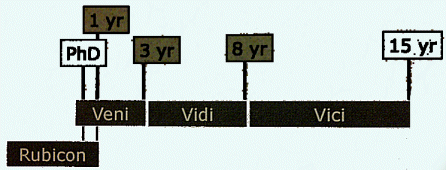
Newton Fund
It is part of the UK’s official development assistance and aims to develop science and innovation partnerships that promote the economic development and social walfare of developing countries. The fund is £75 million each year from 2014 for 5 years.
Nuffield Foundation
UK-based organization which funds programmes aim to improve social well-being in one of two ways:
- By funding research and innovation in education and social policy.
- By increasing the proliferation and quality of research and professional skills – both in science and social sciences – through our capacity building programmes.
Offers science bursaries for colleges and schools and undergraduate research bursaries.
Research4Life
Together the three United Nations sponsored programmes—HINARI, AGORA, and OARE—form Research4Life. It provides developing countries with access to and training for academic and professional peer-reviewed content online.
Related to this initiative is the Wiley Open Access Waivers and Discounts list: authors from developing countries are granted complete waivers (71 countries listed) or a 50% discount (44 countries listed) on the article publication charge associated with open access publishing.
Royal Society (UK)
The Royal Society provides a range of grant schemes to support the UK scientific community and foster collaboration between UK based and overseas scientists. Including:
- Early career schemes — support scientists and academics at the start of their career.
- Senior career schemes — provide long-term support to established scientists.
- Innovation and industry schemes — support innovation and links between science and industry.
- Education schemes — support science education and public engagement.
- Research, capacity and infrastructure schemes — help purchase equipment and renovate laboratories.
- Collaboration and travel schemes — support international travel and joint research.
Royal Society of New Zealand
Providing support and encouragement for New Zealand’s researchers, teachers and students through a wide range of funds. These include New Zealand opportunities and international collaborations.
Schweizerische Nationalfonds zur Förderung der wissenschaftlichen Forschung (SNF) /
Fonds National Suisse (FNS) / Swiss National Science Foundation (SNSF)
The SNSF offers a wide range of research funding schemes which are open to scientists and academics of any nationality working in Switzerland.
Science Europe
An association of European Research Funding Organisations (RFO) and Research Performing Organisations (RPO), based in Brussels. It promotes the collective interests of these organizations and supports its member organisations in their efforts to foster European research. It will strengthen the European Research Area through its direct engagement with key partners.
Science4Life
A German initiative to support founders of start-up companies in the field of Life Sciences and Chemistry.
Science and Technology Facilities Council
Supports and funds science & technology in a broad cross-section of the UK research community. Particularly in the fields Biology and Medicine, Energy Research, Environment, and Nuclear Physics.
Volkswagen Foundation
An independent, non-profit organization focusing on selected funding initiatives, currently 20, grouped into the areas: Persons and Structures, International Focus, and Challenges – for Academia and Society. It endeavors to provide effective stimuli for research and to establish forward-looking topics.
Wellcome Trust
Supports excellent researchers in biomedical research and the medical humanities, with the aim of improving human and animal health.
Scholarships to Study Abroad |
StudyAbroad.com
General information for various countries
Abroad101 (studyabroad101.com) compiles reviews that help American students and their parents better understand their study abroad options and set expectations as to what to expect while abroad
Chemistry programs: studyabroad101.com/subjects/chemistry
Scholarships: studyabroad101.com/scholarships
German Students
- Auslands-Bafög
- Erasmus
- DAAD (Deutscher Akademischer Auslandsdienst/German Academic Exchange Service)
- Bayer-Stiftung
- Deutschlandstipendium
- Studienstiftung
- Fulbright
- Deutsch-Amerikanischer Club
- Deutsch-Französisches Jugendwerk
- GFPS
- GERiT (German Research Institutions)
- CHE-Studienkredit-Test
- Festo-Bildungsfond
► If you know of any additional sources of funding, please either sign in and leave a comment or contact us and we will add it to the list.
- see also: Awards Accepting Nominations