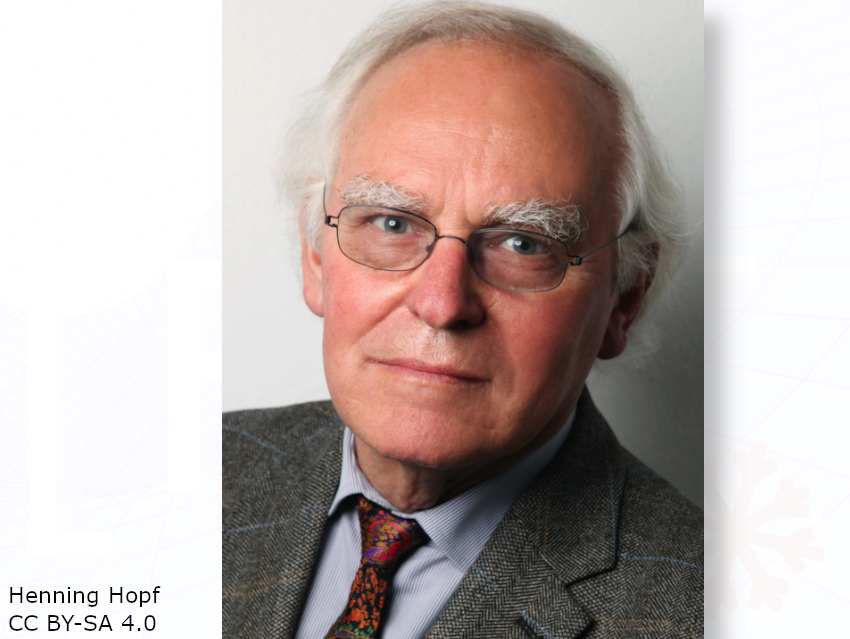
Professor Henning Hopf, Technische Universität Braunschweig, Germany, celebrates his 85th birthday on December 13, 2025. He is an organic chemist and prolific author known his long service to the scientific community, and his research focused on unsaturated compounds such as cyclophanes, alkynes, allenes, cumulenes, and retinoids.
Henning Hopf studied chemistry at the University of Göttingen, Germany, and received his Ph.D. in 1967 from the University of Wisconsin–Madison, WI, USA, under the supervision of Harlan L. Goering. He completed his habilitation with Hans Musso at the Universities of Marburg and Karlsruhe, both Germany. After finishing his habilitation in 1972, he remained at the University of Karlsruhe and became Professor at the University of Würzburg, Germany, in 1975. He moved to the Technische Universität Braunschweig in 1978. Until his retirement in 2006, he served as Managing Director of the Institute for Organic Chemistry.
Among many other honors, Henning Hopf has received the Max Planck Research Award (1994), the Adolf von Baeyer Commemorative Medal (1996), the Literature Prize of the German Chemical Industry Fund (FCI) (2001), the Hanuš Medal of the Czech Chemical Society (2009), the Gmelin–Beilstein Commemorative Medal from the German Chemical Society (GDCh) (2014), and the Primo Levi Prize awarded jointly by the GDCh and the Italian Chemical Society (SCI) (2023).
He served on the Board of Trustees of the German Chemical Industry Fund (FCI) from 2002 to 2008 and was President of the GDCh from 2004 to 2005. He is a Chemistry Europe Fellow and has served as Editor of several scientific journals, including Chemische Berichte (now European Journal of Inorganic Chemistry) and Liebigs Annalen (today’s European Journal of Organic Chemistry).
Selected Publications
- Unexpected Side Products in the Large-Scale Preparation of 2,3-Dihydro-1,1,2,2,3,3-hexamethyl-1H-indene,
Vitaly Raev, Armin de Meijere, Henning Hopf, Peter G. Jones,
Synlett 2025, 36(08), 1069-1073.
https://doi.org/10.1055/s-0043-1775440 - Synthesis of 3(2H)‐Furanones: A Review,
Vishnu K. Omanakuttan, Jubi John, Henning Hopf,
Eur. J. Org. Chem. 2020.
https://doi.org/10.1002/ejoc.202001005 - Superbase-Mediated Indirect Friedländer Reaction: A Transition Metal-Free Oxidative Annulation toward Functionalized Quinolines,
Rahul P., Nitha P. R., Vishnu K. Omanakuttan, Sheba Ann Babu, P. Sasikumar, Vakayil K. Praveen, Henning Hopf, Jubi John,
Eur. J. Org. Chem. 2020, 2020, 3081–3089.
https://doi.org/10.1002/ejoc.202000365 - One-world chemistry and systems thinking,
Stephen A. Matlin, Goverdhan Mehta, Henning Hopf, Alain Krief,
Nature Chemistry 2016, 8, 393–398.
https://doi.org/10.1038/nchem.2498 - Dendralenes Branch Out: Cross-Conjugated Oligoenes Allow the Rapid Generation of Molecular Complexity,
Henning Hopf, Michael S. Sherburn,
Angew. Chem. Int. Ed. 2012, 51, 2298–2338.
https://doi.org/10.1002/anie.201102987 - Fast, Ligand- and Solvent-Free Synthesis of 1,4-Substituted Buta-1,3-diynes by Cu-Catalyzed Homocoupling of Terminal Alkynes in a Ball Mill,
Robert Schmidt, Rico Thorwirth, Tony Szuppa, Achim Stolle, Bernd Ondruschka, Henning Hopf,
Chem. Eur. J. 2011, 17, 8129–8138.
https://doi.org/10.1002/chem.201100604 - Humoristische Chemie: Geschichten aus dem Wissenschaftsalltag (in German),
Ralf A. Jakobi, Henning Hopf (eds.),
Wiley-VCH, Weinheim, Germany, 2010.
ISBN: 978-3-527-30628-2 - Energetic assessment of the Suzuki–Miyaura reaction: a curtate life cycle assessment as an easily understandable and applicable tool for reaction optimization,
Franziska Schneider, Tony Szuppa, Achim Stolle, Bernd Ondruschka, Henning Hopf,
Green Chem. 2009, 11, 1894–1899.
https://doi.org/10.1039/b915744c - [2.2]Paracyclophanes in Polymer Chemistry and Materials Science,
Henning Hopf,
Angew. Chem. Int. Ed. 2008, 47, 9808–9812.
https://doi.org/10.1002/anie.200800969 - Modern Cyclophane Chemistry,
Rolf Gleiter, Henning Hopf (eds.),
Wiley-VCH, Weinheim, Germany, 2004.
ISBN: 978-3-527-30713-5 - Classics in Hydrocarbon Chemistry: Syntheses, Concepts, Perspectives,
Henning Hopf,
Wiley-VCH, Weinheim, Germany, 2000.
ISBN: 978-3-527-29606-4