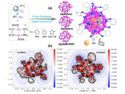
David A. Leigh, University of Manchester, Manchester, UK, and East China Normal University, Shanghai, and colleagues have created a new class of tiny molecular motors that rotate continuously about a single covalent bond using only their own built-in chiral asymmetry, no external chiral fuels or enzymes needed. The motors are based on an azaindole–phenylethanoic acid scaffold with a single stereogenic center. The stereocenter creates the asymmetry needed for directional rotation.
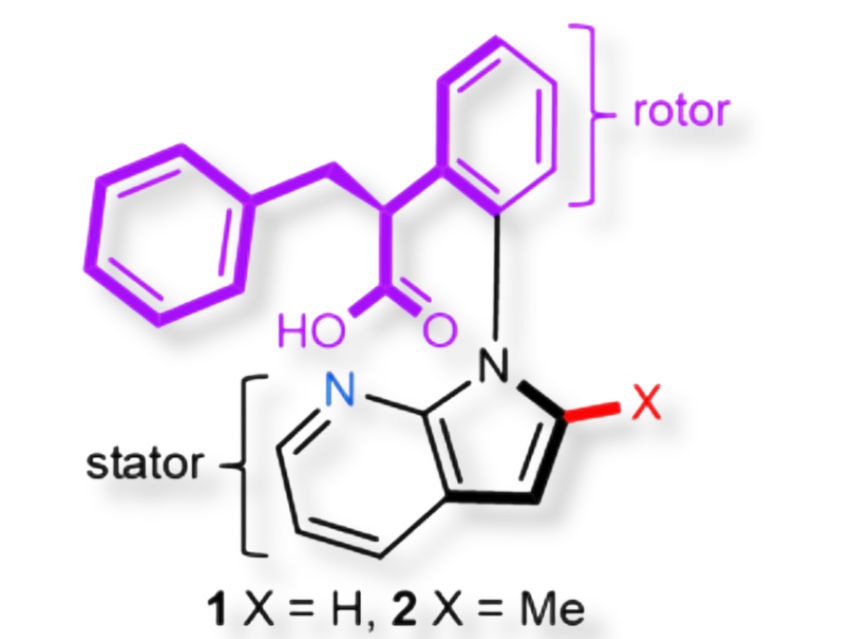
The molecular motors are built from a 7-azaindole “stator” connected via a C–N bond to a phenyl rotor bearing a stereogenic alkyl-ethanoic acid side chain. The carboxylic acid group catalyzes the hydration of diisopropylcarbodiimide (DIC), which fuels continuous, directional rotation of the phenyl ring. The stereogenic center on the rotor side chain determines the intrinsic rotational bias. It generates diastereomeric conformations during the catalytic cycle, producing an 8:1 (clockwise:counter-clockwise) clockwise bias with achiral fuel. Changing the substituent at the stereogenic center (e.g., benzyl → bis(trifluoromethyl)benzyl) can increase clockwise directionality (from 8:1 to 30:1).
Adding a chiral hydrolysis promoter to a motor (with an methyl substituent) allows fine-tuning or reversal of motor rotation: when the motor’s chirality matches the promoter, directionality is enhanced/it rotates faster (about 6-fold increase); when the chirality of the motor and hydrolysis promoter mismatches, the motor reverses its preferred rotation (1:2 clockwise:counterclockwise).
This shows that a single chiral motor can be powered to rotate either along or against its preferred direction, providing insight into how chemical energy drives directional motion at the molecular level, analogous to biological motor proteins.
The work shows how intrinsic molecular asymmetry can drive motion without enzymes or complex fuels, mimicking biological motor proteins. According to the researchers, this opens doors to designing programmable, fuel-efficient nanoscale machines for applications in drug delivery, molecular robotics, and responsive materials.
- Chiral catalysis-driven rotary molecular motors
Hua-Kui Liu, Benjamin M. W. Roberts, Stefan Borsley, Ralph W. Adams, George F. S. Whitehead, Avantika Hasija, David A. Leigh
Nature Chemistry 2026
https://doi.org/10.1038/s41557-025-02050-0