First examples of planar tetracoordinate flourine atoms in binary M₄F₄⁻ (M = Li, Na) clusters have been predicted using quantum chemical methods
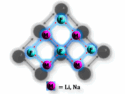
First examples of planar tetracoordinate flourine atoms in binary M₄F₄⁻ (M = Li, Na) clusters have been predicted using quantum chemical methods

Max von Delius, Kerstin Leopold, and colleagues developed sulfur-rich network polymers that show excellent metal sorption and battery cathode performance

The EYCN, representing early-career chemists across Europe, and the EIIL, a network of industrial leaders, have partnered to advance leadership development, bridging academia and industry
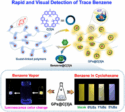
Supramolecular polymers based on calix[3]acridan allow quick and visible detection of trace benzene vapor with high sensitivity and selectivity.
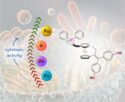
The modification of ferrociphenol by appending a phosphine moiety to the cyclopentadienyl ring (initially unsubstituted) of the ferrocene unit offers a new and promising approach to enhancing this anticancer agent and enables the synthesis of novel biologically active derivatives.

What insights can we get from a daisy chain structure without a preferential low-energy arrangement of mechanically linked components?
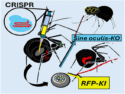
CRISPR-Cas9 was used to edit spider genes, revealing their roles in eye development and enabling fluorescent silk production for the first time.
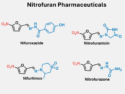
Automated continuous flow synthesis enables rapid nitration of furfural to produce nitrofuran-based pharmaceuticals with high yields in five minutes.
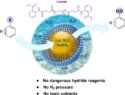
A nickel-catalyzed method for the hydro- and deuterodehalogenation of (hetero)aryl halides under aqueous micellar conditions achieves high efficiency and excellent yields in over 40 examples.

Sebastian Hasenstab-Riedel and Carsten Müller, Germany, and colleagues have spent over a decade investigating the fascinating behavior of the [F₅]⁻ anion in a cryogenic neon matrix