.gif)
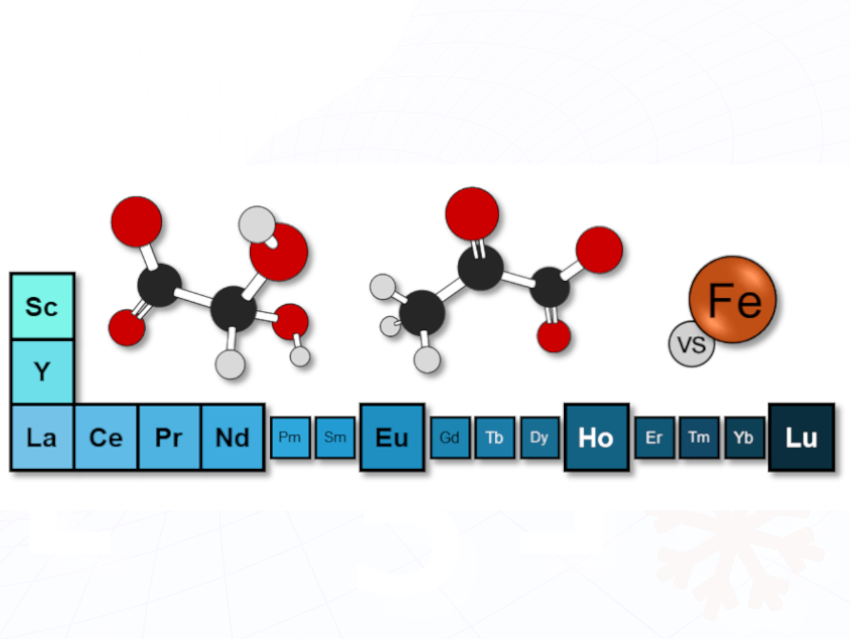
Lena Daumann, Jonathan Gutenthaler-Tietze and Carolina Heßler, Heinrich-Heine-Universität Düsseldorf, Germany, investigate whether rare earth elements can mediate a prebiotic reaction network similar to the Krebs cycle, starting from glyoxylate and pyruvate.
The Krebs cycle, also called the citric acid cycle, is a key metabolic pathway in cellular respiration. Pyruvate and glyoxylate are small, simple molecules that can plausibly form under early-Earth conditions and serve as key intermediates in modern carbon metabolism.
What did you do?
Starting from the prebiotically plausible small organic acids, pyruvate and glyoxylate, we investigated the potential of different rare earth element (REE) salts as mediators in a prebiotic reaction network based on the biological Krebs cycle. A similar network was previously shown to be moderated by ferrous iron [1].
With emphasis on a comparison of REEs, especially La³⁺, with Fe²⁺, we examined the influence of these ions on the range and distribution of the formed products.
Why are you interested in rare earth elements in this context?
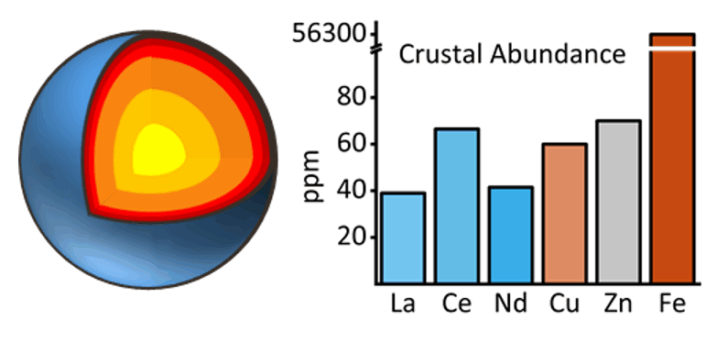 REEs, most likely due to their falsely attributed scarcity, have so far been flying under the radar of Origins of Life research. However, they are widely abundant, and due to their beneficial properties, they can act as excellent Lewis acids in aqueous media. This makes them valuable reagents for different reactions and, as we show now, also in prebiotic scenarios.
What is new and cool about your research?
This study is the first systematic investigation of REEs in the context of prebiotically plausible scenarios.
Metal ions are important biological co-factors and are thus essential for life as we know it. REEs are the most recent addition to the series of biologically relevant metals. Specifically, they are used by methylotrophic bacteria in the active sites of methanol dehydrogenase enzymes [2] and may have played a role in the development of life from the very beginning.
What are your key findings?
With glyoxylate and pyruvate as starting substrates, we observed a rich product spectrum. The ionic radius of the REE ion seems to dictate the reactivity, since, for example, Y³⁺ and Ho³⁺, both of which have very similar ionic radii, deliver essentially an identical product distribution.
Additionally, the pH of the aqueous medium strongly influences the observed reactivity, with mildly acidic conditions producing the broadest spectrum of products through sequential aldol condensations and decarboxylations. Slightly basic conditions, on the other hand, favor Cannizzaro reactions yielding the reduced starting materials, glycolate and lactate.
A promising finding is the observed reactivity of the used salts even at very low, substoichiometric concentrations.
What is the longer-term vision for your research?
This was just a first step in the investigation of REEs in the context of Origins of Life. While this study focused on the factor of Lewis acidity, other aspects, such as the oxidative capabilities and potential photoredox catalysis of cerium, remain to be explored, as well as mechanistic insights into these networks.
What part of your work was the most challenging?
The most challenging aspect was analyzing the highly complex product spectrum and finding a way to work up samples for analysis without changing the product distribution. Only the combined use of NMR and gas chromatography–mass spectrometry (GC–MS) analysis provided a more comprehensive overview of the products formed.
Thank you very much for sharing these insights, and all the best in your continued research.
The paper they talked about:
- Influence of Rare Earth Elements on Prebiotic Reaction Networks Resembling the Biologically Relevant Krebs Cycle,
Jonathan Gutenthaler-Tietze, Carolina G. Heßler, Lena J. Daumann,
Angew. Chem. 2025.
https://doi.org/10.1002/anie.202516853
References
[1] K. B. Muchowska, S. J. Varma, J. Moran, Synthesis and breakdown of universal metabolic precursors promoted by iron, Nature 2019, 569, 104–107. https://doi.org/10.1038/s41586-019-1151-1
[2] N. Picone, H. J. Op den Camp, Role of rare earth elements in methanol oxidation, Curr. Opin. Chem. Biol. 2019, 49, 39–44. https://doi.org/10.1016/j.cbpa.2018.09.019
Lena Daumann is a professor at the Lehrstuhl für Bioanorganische Chemie, Heinrich-Heine-Universität Düsseldorf, Germany.
Jonathan Gutenthaler-Tietze is a postdoc at the Lehrstuhl für Bioanorganische Chemie, Heinrich-Heine-Universität Düsseldorf, Germany.
Also of Interest
Lena Daumann and Sophie Gutenthaler-Tietze share their research and experiences filming for a popular German children’s program and other outreach activities
Bacteria can replace lanthanides with actinides to sustain their metabolism