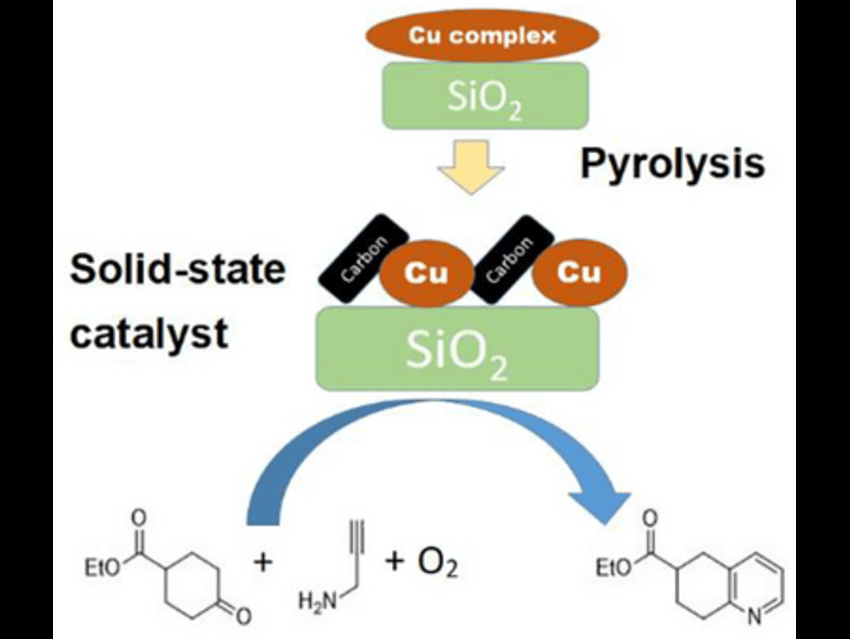
Sergey V. Kolotilov, National Academy of Sciences of Ukraine, Kyiv, Ukraine, and his colleagues wanted to understand how copper and carbon components contribute to the catalytic synthesis of fused pyridines. The central challenge was to determine whether Cu is essential, whether carbonaceous materials alone can drive the reaction, and how side reactions influence yields.
The team prepared seventeen composites by pyrolyzing Cu²⁺ complexes with phenanthroline and 1,2-diaminobenzene (DAB) on SiO₂; some materials contained Cu₂O or CuCl, and one Cu-free composite was prepared from MgCl₂ and DAB. Powder X-ray diffraction (PXRD) and transmission electron microscopy (TEM) revealed Cu nanoparticles with sizes of 20–37 nm, while Raman spectroscopy indicated defect-rich carbon coatings and nitrogen adsorption measurements determined surface areas.
The composites were evaluated in the cycloaddition of propargylamine with ethyl 4-oxocyclohexanecarboxylate to form ethyl 5,6,7,8-tetrahydroquinoline-6-carboxylate. Product yields decreased with increasing carbon content due to side reactions that consumed propargylamine. During repeated catalytic cycles, Cu gradually leached from the materials, decreasing from ~5.3 wt% to ~2.3 wt% after four runs; nevertheless, catalytic activity persisted, indicating that Cu is not the sole active species.
The reaction pathway involves cyclization and oxidative aromatization, both of which can proceed without Cu because carbonaceous species catalyze benzannulation, oxidation, and dehydrogenation. Three active catalysts (Cu@SiO₂, Cu@SiO₂, and Cu@SiO₂) produced substituted fused pyridines from various ketones in 35–52% yield, as confirmed by NMR and LC–MS.
The key finding is that product yield does not correlate with Cu content; instead, catalytic activity is governed by carbon defects and heteroatom doping, while excessive carbon promotes side reactions. The novelty of this work lies in demonstrating that nitrogen-doped carbon materials can catalyze pyridine formation even in the absence of Cu, highlighting carbon’s active role and offering a path toward greener, more stable, and potentially metal-free catalysts for heterocycle synthesis. This insight may enable more sustainable and cost-effective processes in pharmaceutical and fine chemical production.
- Carbon-Coated Copper Nanoparticles for Heterogeneous Catalytic Synthesis of Fused Pyridines: The Role of Cu and C Components
Dmytro V. Yehorov, Svitlana O. Sotnik, Vitalii M. Asaula, Olena O. Pariiska, Evgenia V. Senchylo, Illia Pavliei, Igor E. Kotenko, Anastasiya V. Terebilenko, Alexander B. Rozhenko, Konstantin S. Gavrilenko, Serhiy V. Ryabukhin, Dmytro M. Volochnyuk, Sergey V. Kolotilov
ChemistrySelect 2025
https://doi.org/10.1002/slct.202501880