Achieving pure enantiomers of atomically precise metal nanoclusters is a major challenge in nanotechnology, as most syntheses produce racemic mixtures that require tedious separation. Homochiral nanomaterials are highly desired for applications such as chiral sensing, asymmetric catalysis, and circularly polarized luminescence (CPL). Strategies to induce chirality often rely on chiral ligands or postsynthetic resolution, but a direct synthetic route to homochiral clusters using achiral components is rare and scientifically insightful.
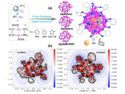
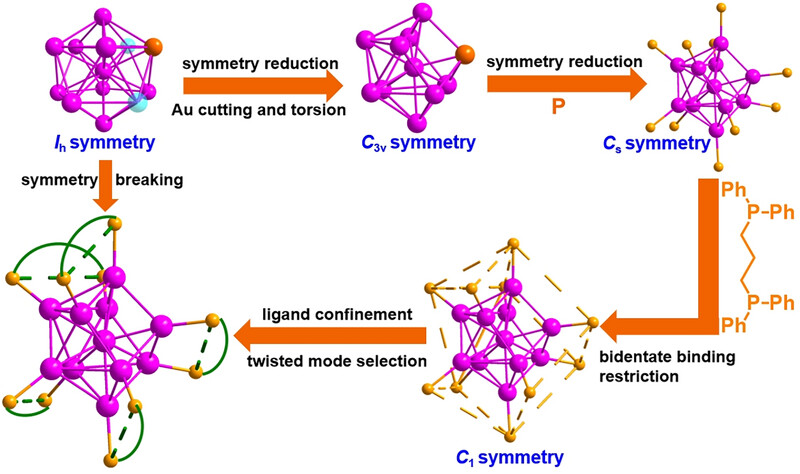
Gao Li, Inner Mongolia Normal University, China, and colleagues reported the direct synthesis of homochiral, enantiopure Au₁₁ nanoclusters protected by achiral 1,3-bis(diphenylphosphino)propane (dppp) ligands. The key to achieving homochirality was the formation of strained “ansa‑metallamacrocycles” (Au–P–CH₂CH₂CH₂–P–Au staples) in which the bidentate dppp ligands wrap around the Au₁₁ kernel. This ligand confinement breaks the inherent symmetry of the cluster core, resulting in a chiral structure.
Synchrotron X‑ray diffraction confirmed the atomic structure and the absence of inversion or mirror symmetries. The team characterized the homochirality using ³¹P NMR, which showed ten distinct phosphorus environments, confirming the lack of symmetry. Circular dichroism (CD) and strong circularly polarized luminescence (CPL) with a dissymmetry factor (g) of 0.032 verified the homochiral nature in both ground and excited states.
Density Functional Theory (DFT) calculations revealed a low energy barrier (9.3 kcal/mol) for the symmetry-breaking deformation in Au₁₁, facilitated by the optimal fit of the propane bridge. This explains why this cluster forms a single enantiomer directly, unlike the analogous Au₁₃ cluster, which racemizes.
According to the researchers, this work demonstrates a novel ligand-induced strain strategy for the direct synthesis of homochiral nanoclusters from achiral precursors. It provides valuable insights into the origin of chirality and offers a promising route for designing chiral nanomaterials.
- Symmetry Breaking in Chiral Gold Nanoclusters by Ansa-Metallamacrocycles Strain
Zhiwen Li, Jingjing Zhang, Zhaoxian Qin, Huan Li, Zhaohui Tong, José A. Gascón, Gao Li
Aggregate 2025
https://doi.org/10.1002/agt2.70168