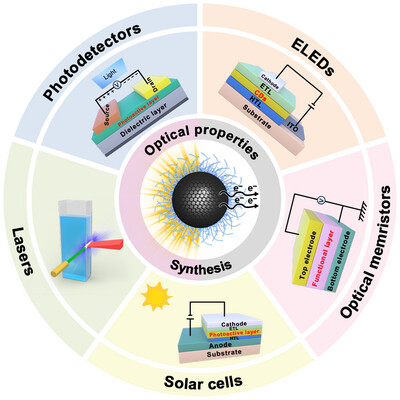
Carbon dots (CDs), a distinctive class of fluorescent, zero‑dimensional, carbon nanomaterials, integrate exceptional optical and electronic characteristics, including broad spectral absorption, tunable photoluminescence, high quantum yield, superior photostability, and adjustable fluorescence lifetime, positioning them as promising candidates for optoelectronic applications.
Their wide absorption range—from ultraviolet to near-infrared—enables the design of broadband-responsive photodetectors. Abundant surface states facilitate electron-hole separation, suppress recombination, and enhance photocurrent output, thereby improving photovoltaic performance.
Exceptional stability and solution processability make CDs suitable for incorporation into electroluminescent light-emitting diodes, while narrow-band emission from optimized structures satisfies the requirements for laser gain media. Furthermore, their tunable band structure, ultrasmall dimensions, and compatibility with flexible substrates render them ideal for constructing photosensitive memristors.
Siyu Lu, Zhengzhou University, China, and colleagues provide an extensive overview of CDs, covering synthesis strategies, unique optical features, and recent advancements in optoelectronic applications. Particular emphasis is placed on their integration into photodetectors, photovoltaic devices, electroluminescent diodes, lasers, and photosensitive memristors (electronic devices that combine memory and light sensitivity).
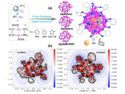
The article explains that carbon dots (CDs) are typically synthesized from carefully chosen molecular precursors, such as citric acid or phloroglucinol, with reaction conditions and post-processing tailored to control their size, surface states, and optical properties. By selecting specific precursors and regulating the structure, researchers can produce CDs with high quantum yield, tunable photoluminescence, and narrow emission bands.
Current research demonstrates strong device potential but lacks a comprehensive framework linking CD structure, optical properties, and device performance. Key challenges include optimizing quantum yield, emission tunability, and integration into high-performance devices. Future work should focus on systematic synthesis–property studies, enhanced optical control, and rational device design to fully realize advanced CD-based optoelectronic technologies.
Overall, by addressing these aspects, this review aims to establish a roadmap for developing advanced CD-based optoelectronic technologies.
- Carbon Dots: Small Materials with Big Impacts on Optoelectronic Devices
Boyang Wang, Junwei Wang, Siyu Lu
Aggregate 2025
https://doi.org/10.1002/agt2.70212