Polyoxometalates (POMs) are valued for their remarkable structural diversity, nanoscale dimensions, and rich redox chemistry. Their niobium-based relatives, polyoxoniobates (PONbs), are more difficult to synthesize. Yet these materials are particularly attractive because of their high stability and strong potential in areas such as nuclear waste remediation and energy-related applications. Developing new synthetic routes or discovering new structures is therefore crucial.
Progress in this field has been slow, largely because polyoxoniobates often require harsh synthesis conditions and tend to form only a limited range of architectures, lagging behind other POM families.
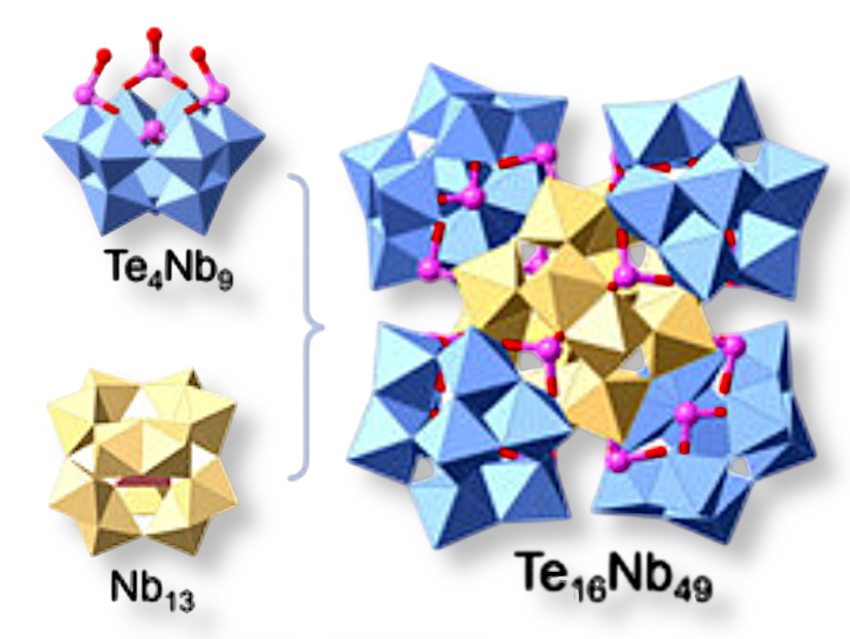
Cai Sun and colleagues, Fuzhou University, China, have reported a tellurium-containing polyoxoniobate assembled using tellurite ions as structure-directing agents. The team synthesized a large telluroniobate cluster with the formula H₁₈K₂₀{Nb₁₃O₄₂] (Te₄Nb₉O₃₃)₄}·50 H₂O (referred to as compound 1).
The anion contains 49 niobium and 16 tellurium atoms and is built around a previously unknown {Nb₁₃} core (pictured above). This central unit differs from classical Keggin- and Silverton-type building blocks, pointing toward a new structural direction in polyoxoniobate chemistry: The Keggin structure forms tetrahedral {XO₄} coordination via four trimetallic {M₃O₁₀} clusters sharing internal oxygens. The Silverton structure forms icosahedral {XO₁₂} coordination from six bimetallic {M₂O₉} clusters sharing two internal oxygens each, while the New-type structure forms octahedral {XO₆} coordination from six bimetallic {M₂O₉} clusters sharing one internal oxygen each.
Tellurite ions (TeO₃²⁻) play a decisive role in this synthesis. Their stereochemically active lone pairs disrupt the usual Lindqvist-type niobium clusters, generating reactive vacancy-containing intermediates that can assemble into entirely new PONb structures. Under hydrothermal conditions, these modified building units come together to form the final telluroniobate framework. This anion-templating strategy provides a practical route to architectures that are otherwise difficult to obtain.
Beyond structural novelty, the new compound also shows impressive functional behavior. As POMs are promising proton-conducting materials (due to their relatively low surface negative charge), compound 1 was evaluated for proton conductivity using alternating current impedance measurements under varying temperature and humidity conditions. The results reveal proton conductivity superior to that of most reported proton-conductive materials. At 85 °C and 98% relative humidity, compound 1 reaches a conductivity of 1.1 × 10⁻² S·cm⁻¹, a performance attributed to its high water content and good structural stability.
Temperature-dependent measurements indicate a Grotthuss-type transport mechanism, in which protons move efficiently through an extended hydrogen-bonded water network by hopping between neighboring water molecules. This is particularly relevant for energy conversion and storage technologies.
Overall, this work demonstrates how anion templating can unlock new polyoxoniobate architectures while simultaneously delivering useful functional properties. Tellurium-templated niobates may therefore offer promising opportunities for the development of next-generation proton-conducting materials in future energy technologies.
- A New Telluroniobate Te16Nb49: Synthesis, Structure, and Proton Conductivity Property
Lei Jia, Wei-Chao Yang, Yi-Xin Liu, Cai Sun, Shou-Tian Zheng
Eur. J. Inorg. Chem. 2026
https://doi.org/10.1002/ejic.202500616